Dr. Mona Molham: Blazars, gravitational waves, and belonging in science
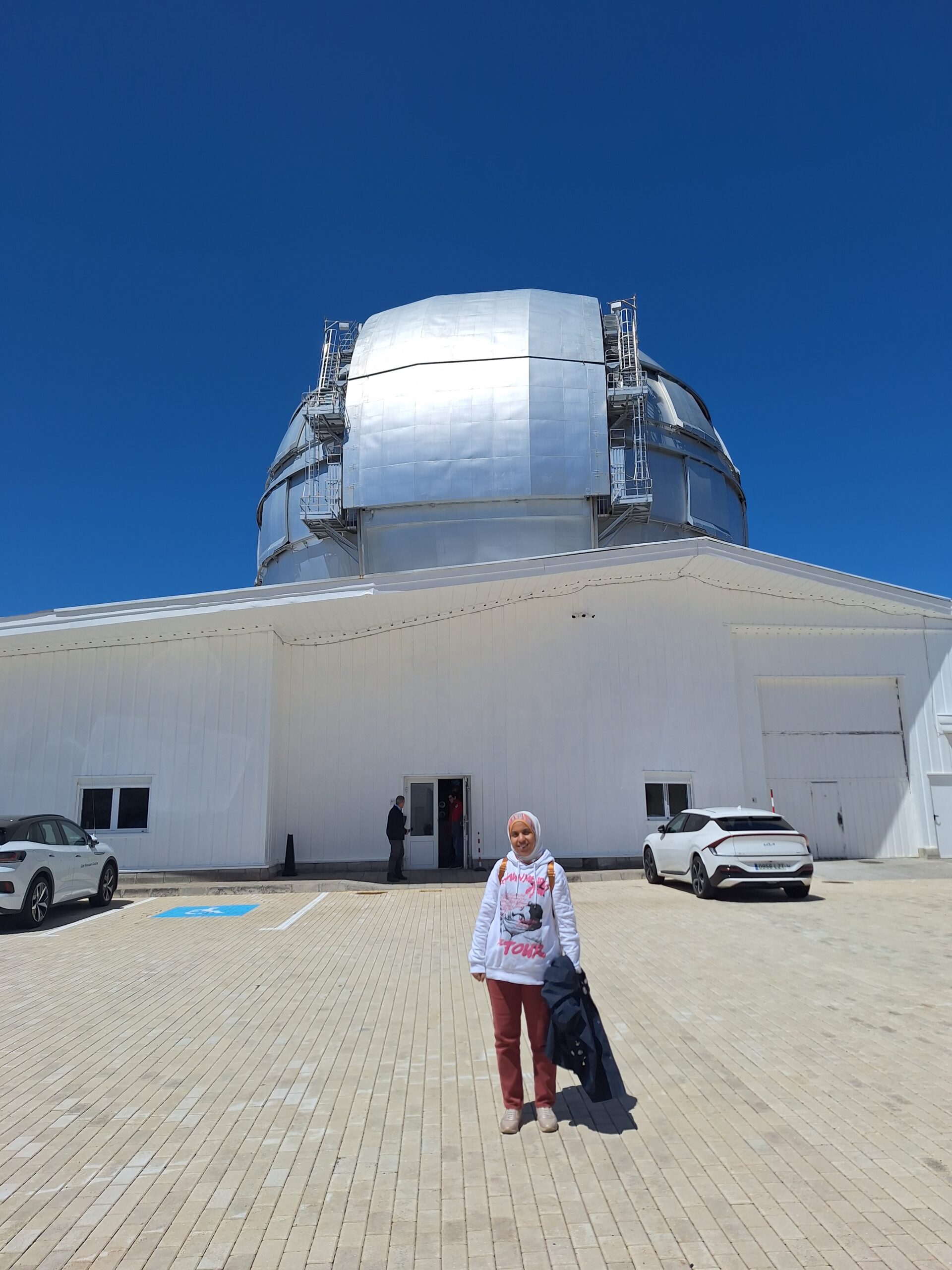
Wednesday, May 27, 2026 – It started with a meteor. A bright streak across an Egyptian sky, and a child with a question nobody could answer. Today, Dr. Mona Molham studies blazars and helps coordinate real-time observations across 25 telescopes worldwide as part of the GRANDMA collaboration. She is also a Science by Women alumna who carried her research stay at Instituto de Astrofísica de Canarias and the recipient of the AfNWA–ISP Prof. Carolina Ödman-Govender Early Career Award, a distinction that honours not only scientific excellence but the significance of her journey as an African woman in a field where representation remains rare.
Can you tell us about yourself and your journey into astronomy? What first drew you to studying the universe?
I was just a curious kid who asked too many questions. I grew up in Egypt and there was this moment when I saw a meteor, a tailed star streaking across the sky, bright and fast. And nobody around me had a real answer for where it came from or where it went. That question just stayed with me.
The “Science by Women” programme brought you to one of the world’s leading astrophysics institutes. Looking back, how did that opportunity concretely impact your career?
Those six months in Tenerife really changed my life. It gave me dedicated time and world-class infrastructure to really dig into my research on blazars. I built collaborations that are still active, I gained confidence in my own scientific work, and I came back to Egypt with a much clearer vision of where I wanted to go.
You are part of the GRANDMA collaboration, coordinating follow-up observations across 25 telescopes worldwide. What does that work look like day to day, and what makes it so exciting?
Somewhere in the universe, two neutron stars collide. That collision sends ripples through spacetime itself, gravitational waves’. Detectors pick up the signal, and within about five minutes, an alert goes out to astronomers around the world. Then we have to coordinate 25 telescopes across the planet to look at the right patch of sky before the signal disappears. Sometimes we have the first telescope observing within 20 minutes of the alert. My role is helping make sure the right telescope is pointing at the right place at the right time. What makes it thrilling is that you never know what the universe is about to tell you, and you have to be ready.
You were recently awarded the AfNWA–ISP Prof. Carolina Ödman-Govender Early Career Award. What does this recognition mean to you personally and professionally?
Carolina Ödman-Govender was someone who dedicated her life not just to astronomy but to making sure African women had a real place in this field. Having my name connected to her feels like a responsibility as much as an honor. And on a personal level, it just meant so much to be seen. To have the community say, your work matters, your journey matters.
As a woman in science from Egypt, what have been your biggest challenges — and what has kept you going?
There were moments when I felt out of place, where I doubted whether I really belonged. Resources aren’t always there, role models who look like you aren’t always visible, and sometimes you’re just tired of being one of the very few women in the room. But every time I thought about stopping, I’d remember why I started, because I love this. The questions, the data, the moments when something clicks. And the people around me. mentors who believed in me before I fully believed in myself, colleagues who became friends.
What advice would you give to a young African woman who dreams of becoming a scientist but feels the path is too far away?
Apply for things that scare you a little. Reach out to people you admire, even if it feels awkward, the worst they can say is no. Find your people, even if it starts online. And please don’t let anyone make you feel like your dream is too big or too far.The universe is vast and it has room for all of us.
What is the one thing you hope your work — both your science and your outreach — leaves behind?
For science, I want to keep pushing my work further and contribute something meaningful to our understanding of these incredible, extreme objects in the universe. And for outreach, I just want some kid in Egypt, or anywhere in Africa, to look up at the sky one day and think maybe I can do this too.