African Women Speak Out: Science and Knowledge in African Languages
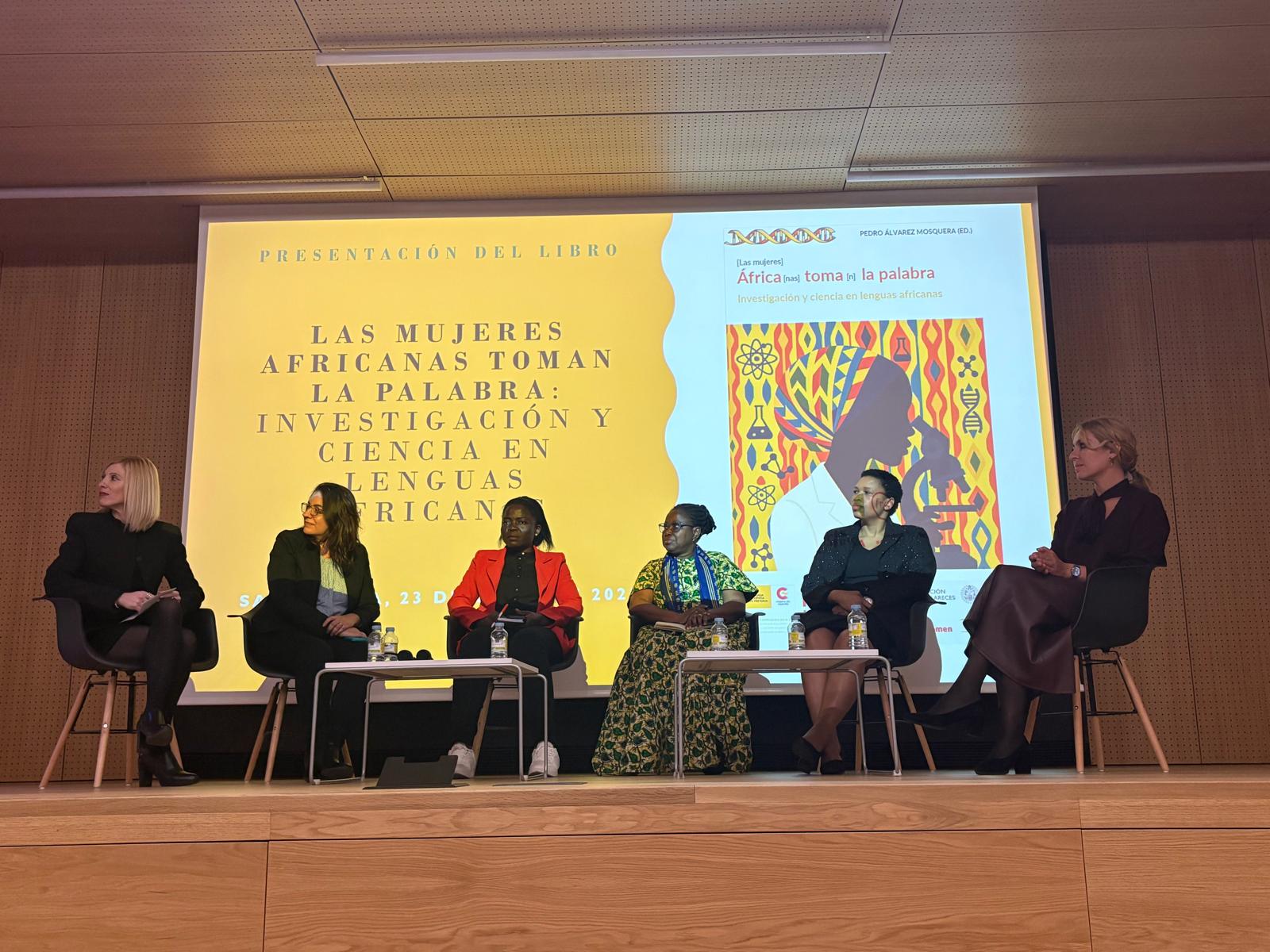
Madrid, October 27th, 2025— Last Thursday, the Centro Internacional del Español (CIE-USAL) hosted the presentation of the book African Women Speak Out: Research and Science in African Languages, a work that highlights the value of scientific knowledge produced in African vernacular languages.
The event featured the participation of Beatriz Santacruz, Project Coordinator at the Women for Africa Foundation; Dr. Alba Gómez Arias, President of ACESDA; Estefanía Calcines Pérez, Head of the Media Library and Web Area at Casa África; and researchers Emeline Sergine Ngatat (Cameroon), Manoko Maubane-Nkadimeng (South Africa), and Evelyn Yayra Afua Bonney (Ghana), who are currently conducting research residencies in Spain thanks to the Foundation’s Science by Women programme. The roundtable was moderated by Dr. Pedro Álvarez-Mosquera, editor of the volume and Associate Professor at the University of Salamanca.
During the discussion, the researchers shared their personal experiences and reflected on the challenges and strategies involved in conducting and communicating scientific work in their native languages. The conversation underscored the importance of promoting a truly multilingual and accessible science that recognizes the richness of knowledge generated from diverse cultural and linguistic contexts.
The volume, available in open access, can be consulted at the following link: https://eusal.es/eusal/catalog/book/978-84-1091-133-8.
A Project to Make Science in African Languages Visible
The book African Women Speak Out: Research and Science in African Languages is the result of the project Scientific Outreach in African Vernacular Languages, promoted by the Women for Africa Foundation in collaboration with the University of Salamanca, the Centro Internacional del Español (CIE), and ACESDA.
Over the course of more than a year of work, the project has brought together texts by African women researchers participating in the Science by Women programme—now in its tenth edition—as well as by African scientists from the ACESDA network, with the aim of promoting the use and recognition of African languages as valid vehicles for science and highlighting the role of African women in the production and dissemination of knowledge.
Linguistic Diversity, Inclusion, and Gender
Africa is home to more than 2,000 languages, making it the most linguistically diverse continent in the world. However, many of these languages are under threat due to globalization and the predominance of colonial languages. The project seeks to counter this trend by actively promoting the use of vernacular languages in science and education.
This initiative aligns with the objectives of the United Nations International Decade of Indigenous Languages (2022–2032) and responds to the urgent need to diversify science, both in its languages and in its voices.
By offering a platform for African women scientists to publish in their mother tongues, the Foundation reinforces its commitment to gender equality, linguistic diversity, and inclusion in science. The project not only contributes to the preservation and prestige of African vernacular languages, but also facilitates access to knowledge within local communities, breaking down linguistic barriers and strengthening the links between science and society.