Dr.Toyosi Igejongbo is reimagining fisheries governance across West Africa
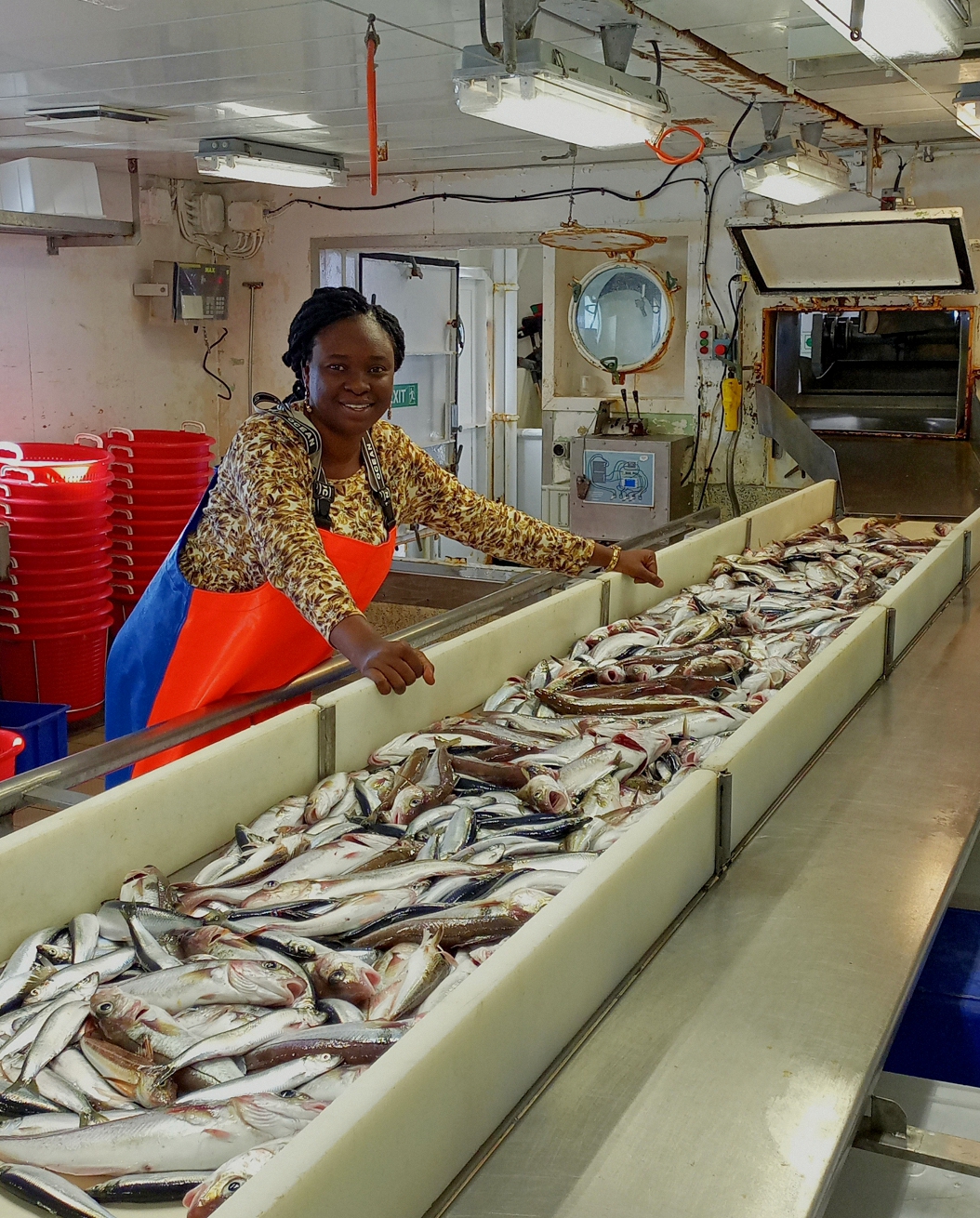
Thursday, May 19, 2026 – The Gulf of Guinea is in crisis. Climate change, dwindling fish stocks, and cross-border tensions are threatening the livelihoods and food security of millions of coastal communities across West Africa and the governance frameworks meant to protect them have not kept pace. Dr.Toyosi Igejongbo, a marine researcher and Science by Women alumna (7th edition), is working to change that.
Her project Fisheries Without Borders brings together Nigeria, Ghana, and Benin in a rare act of transnational scientific and diplomatic cooperation, one that places local ecological knowledge on equal footing with formal research and puts African women at the helm of climate resilience solutions.
In this interview, she reflects on the scientific and political complexities of managing shared marine resources across three sovereign nations, the lasting influence of her time at PLOCAN, and what it means to lead as a woman in a field that has long looked the other way.
What “Fisheries Without Borders” is about and why it is particularly relevant at this moment?
The project was inspired by the growing reality that fisheries in the Gulf of Guinea are under increasing pressure from climate change, resource depletion and rising conflicts among resource users. In my work with coastal communities, I have seen firsthand how changing ocean conditions, declining fish stocks and weak governance structures directly affect livelihoods, food security and social stability. At the same time, there is a wealth of indigenous knowledge and local experience that remains underutilized in formal management systems. This disconnect between science, policy and community realities strongly motivated the development of this project.
This project matters now more than ever because the challenges facing marine ecosystems and coastal populations are intensifying and becoming more complex across national boundaries. Climate change is not only altering fish distribution and productivity but also increasing competition and tensions among fishing communities in the region. Addressing these issues requires urgent, coordinated, and inclusive approaches that go beyond single-country solutions.
Managing fisheries across three sovereign nations is highly complex. What were the main scientific and diplomatic challenges you encountered when designing this project?
Designing a project that spans Nigeria, Ghana, and Benin required us to think beyond science alone because fisheries governance in the Gulf of Guinea is deeply connected to policy, livelihoods, culture, and regional politics. One of the major scientific challenge was integrating different knowledge systems. Coastal communities possess generations of traditional ecological knowledge about fish migration, seasonal changes, and ecosystem behavior, yet this knowledge is often excluded from formal governance frameworks. Our project intentionally creates space for both scientific evidence and indigenous knowledge to complement one another in decision-making.
On the diplomatic side, one key challenge was ensuring balanced representation and trust among stakeholders from different countries and institutions. Fisheries resources in the Gulf of Guinea are shared, but countries may have different national priorities, regulations, and enforcement structures. Building a collaborative framework required careful dialogue to ensure that no country felt marginalized and that all partners saw mutual benefits in regional cooperation.
There were also language and institutional coordination challenges, particularly between Anglophone and Francophone partners, so we invested significant effort in building partnerships based on transparency, inclusiveness, and continuous engagement. Ultimately, these challenges reinforced the importance of regional collaboration. They showed us that sustainable fisheries management in West Africa cannot succeed through isolated national actions alone; it requires trust, shared knowledge, and coordinated governance across borders.
You participated in the 7th edition of Science by Women at PLOCAN. Looking back, which experience during that fellowship was most transformative for your career?
One of the most transformative aspects of my experience during the 7th edition of the Science by Women Program at PLOCAN was the exposure to truly interdisciplinary and international approaches to marine governance and ocean sustainability. The fellowship placed me in an environment where scientists, policymakers, innovators, and technical experts from different parts of the world were working together to solve complex ocean-related challenges. That experience fundamentally changed how I think about fisheries research and leadership.
Before the fellowship, much of my work focused primarily on scientific and ecological dimensions. However, during my time at PLOCAN, I gained deeper insight into how science can be translated into policy, diplomacy, innovation, and community action. I was particularly inspired by the emphasis on collaborative governance, stakeholder engagement, and the use of science as a bridge between institutions and societies. It became clear to me that sustainable marine management cannot succeed through isolated research alone; it requires partnerships that cut across sectors and national boundaries.
Can you trace a direct link between something you learned or a connection you made during Science by Women and a concrete decision you took while developing or pitching this grant?
One important lesson I carried from Science by Women was the importance of building multi-stakeholder and transnational networks early in a project’s design. During the fellowship, I interacted with experts working on ocean governance, blue economy initiatives, climate resilience, and international marine cooperation. Those interactions influenced my decision to intentionally structure this grant around cross-border collaboration between Nigeria, Ghana, and Benin rather than designing it as a country-specific intervention.
The fellowship also strengthened my confidence in positioning African-led research within global conversations on climate resilience and marine sustainability. While developing and pitching the grant, I became more intentional about framing the project not only as a fisheries initiative, but also as a platform for regional cooperation, conflict-sensitive governance, and locally driven climate adaptation. That broader framing was heavily influenced by the interdisciplinary exposure I received at PLOCAN.
As a woman leading a multinational, multi-funded research project in a field historically dominated by men, what barriers have you faced, and how did you overcome them?
As a woman leading a multinational and multi-funded research initiative in fisheries and marine governance, one of the major barriers I have faced is the persistent perception that leadership in technical and field-based sciences should primarily be male-driven. There are moments when my expertise is questioned more rigorously or my leadership is underestimated until I consistently prove my competence through results.
Another challenge has been balancing multiple responsibilities while maintaining visibility in highly competitive scientific environments. I overcame many of these barriers through persistence, collaboration, and continuous professional development. I intentionally built strong scientific networks, sought interdisciplinary partnerships and remained focused on producing impactful work that speaks for itself.
The Fundación Mujeres por África fellowship programme specifically supports African women researchers. In your view, what does this targeted approach enable that more general science funding does not?
What makes the targeted approach of Fundación Mujeres por África so powerful is that it addresses structural gaps that general science funding often overlooks. Many traditional funding systems focus primarily on research outputs without fully considering the unequal barriers women face in accessing opportunities, leadership roles, international mobility, and professional visibility. This fellowship does more than fund research; it builds confidence, networks, mentorship, and international exposure for African women scientists.
It also creates a supportive ecosystem where women can engage with peers facing similar realities. That sense of visibility and belonging is extremely important because representation matters. When African women scientists are intentionally supported, they are more likely to take leadership positions, mentor younger researchers, influence policy discussions, and contribute solutions that are grounded in local realities. In many ways, the program is helping to reshape the future of scientific leadership by ensuring that talented women are not excluded from global conversations simply because of systemic barriers.
What message would you share with a young woman in Nigeria, Ghana, or Benin who is passionate about ocean science but feels that a path toward international research leadership is out of reach?
To a young woman in Nigeria, Ghana, or Benin who dreams of a career in ocean science, I would say this: your background does not limit your potential. International research leadership may sometimes appear distant, especially when resources, mentorship, or opportunities seem limited, but your passion, curiosity and consistency can open doors you may not even imagine today.
Do not be discouraged by environments where you are underestimated or where few women are represented. Instead, focus on building knowledge, seeking mentors, developing collaborations, and remaining open to opportunities beyond your immediate surroundings. Science is increasingly global and interdisciplinary, the world needs more African women contributing their perspectives and solutions to ocean and climate challenges.
Most importantly, believe that your voice and your research matter. The communities along our coasts are facing real environmental and livelihood challenges, and many of the solutions will come from young African scientists who understand these realities firsthand. Leadership is not something reserved for a select few countries or institutions; it grows through commitment, courage, and the willingness to keep learning and contributing despite obstacles.