Reflections on Reconciliation Across African Contexts: A Joint Webinar by Fundación Mujeres por África and the Mandela Rhodes Foundation
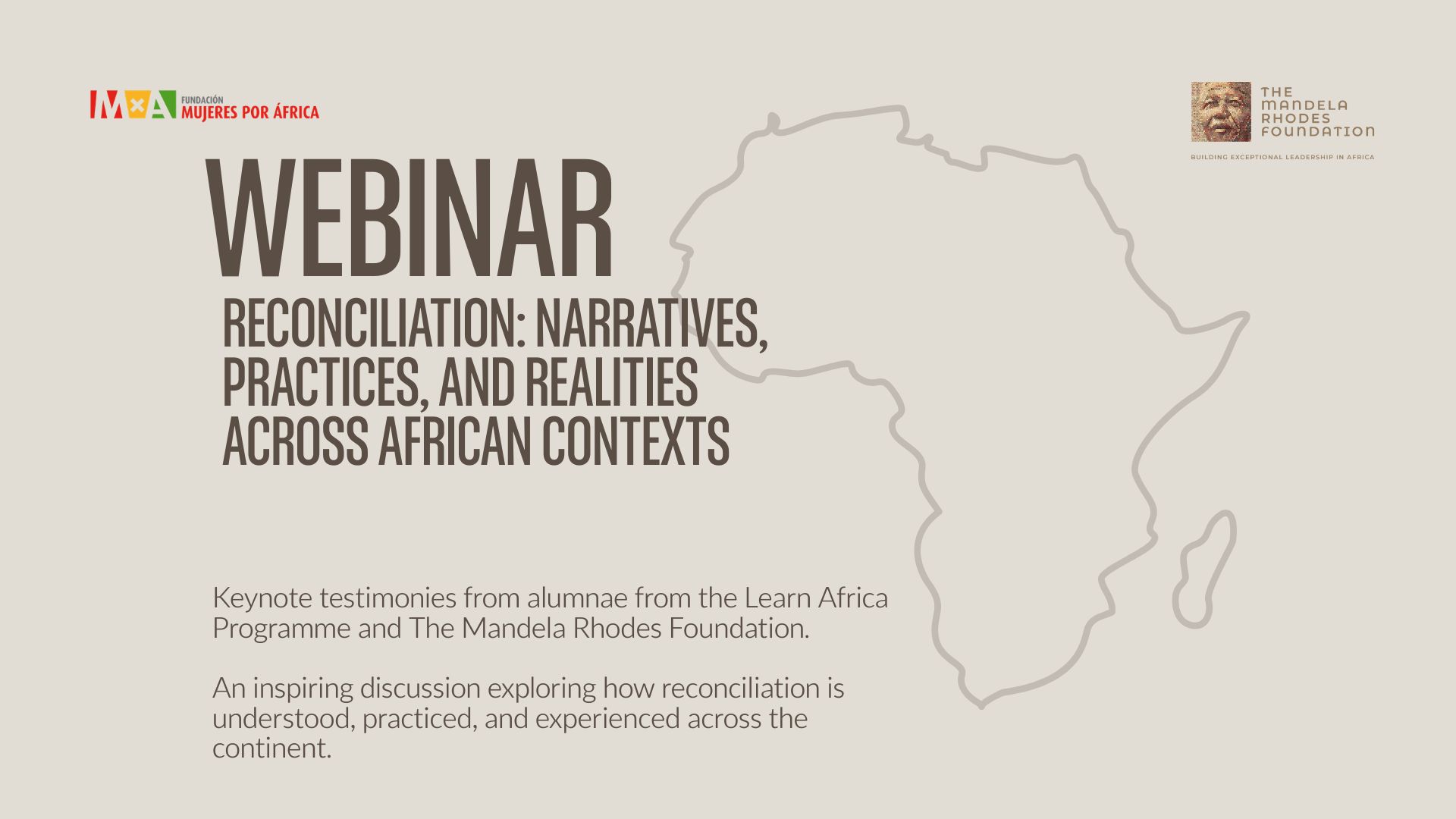
Madrid-Cape Town/online, 18 March 2026 — Last Wednesday, the Fundación Mujeres por África and the Mandela Rhodes Foundation co-hosted the webinar “Reconciliation: Narratives, Practices, and Realities Across African Contexts,” bringing together voices from across the continent to explore the complexities of reconciliation in diverse social, political, and personal contexts.
The session featured key testimonies and a moderated discussion with selected alumnae from the Learn Africa Programme and the Mandela Rhodes Foundation. Through their research and professional work, participants are actively engaged in issues related to reconciliation, peacebuilding, memory, justice, and post-conflict transitions.
Opening remarks were delivered by Kristal Duncan-Williams on behalf of the Mandela Rhodes Foundation, and by Juan Algar, CEO of Fundación Mujeres por África, who both highlighted the importance of fostering dialogue and shared the commitment of both institutions to shaping the future of the African continent.
A central moment of the webinar was the intervention by Coralie Anyetei, Programme Director at the Mandela Rhodes Foundation, who offered an in-depth perspective on reconciliation as both a concept and a lived reality. She emphasized the Foundation’s belief in reconciliation as an inner process—one that requires embracing both light and shadow, confronting pain without being defined by it, and enabling individuals to move forward with agency and purpose.
The webinar then turned to the testimonies of alumnae, whose reflections illustrated the multifaceted nature of reconciliation:
-
Jill Samukimba shared a deeply personal journey of reconciliation, shaped by her experiences navigating identity and loss. Today, she channels this process into her work facilitating mental health workshops and mentorship programmes for orphans, highlighting the importance of inner healing.
-
Sonia Mankongo underscored the role of education as a tool for peace. Drawing on her work in northern Cameroon, she described how teachers in conflict-affected areas can become agents of peace, transforming schools into safe and inclusive spaces.
-
Leané Williams presented dramatherapy and theatre-making as powerful practices of reconciliation. She reflected on the ways in which memory and violence are embodied, and critically examined societal expectations placed on women, as well as the limitations of reconciliation processes that overlook lived realities.
-
Chioma Ibiam Aja highlighted the importance of leadership, mentorship, and access to platforms for women. She emphasized education as a key driver for changing narratives and promoting peace.
-
Iris Nxumalo-de Smidt explored the fragmented and political nature of reconciliation, particularly through the lens of memory. She stressed that for many women and girls, conflict does not truly end, and called for greater investment in feminist alternatives.
-
Betelhem brought an international law perspective, reflecting on her experience of the Tigray conflict during her university years. She advocated for reconciliation as a form of catharsis, grounded in truth rather than amnesia.
The session concluded with closing remarks by Beatriz Santacruz, coordinator of the Learn Africa Programme, who highlighted the importance of creating spaces for dialogue and exchange. She noted that, while the speakers come from different disciplines and contexts, they share a common commitment: contributing to the advancement of the African continent.
This joint initiative marks the first collaboration of its kind between both foundations, reflecting a shared vision of empowering future leaders through education and critical engagement. It also opens the door to future partnerships grounded in common values and a mutual commitment to fostering inclusive and transformative narratives.