Fatoumata Jallow-Tambajang : “When we have the opportunity as leaders to be at the table in negotiations, we must think about those who are voiceless, those who are invisible”
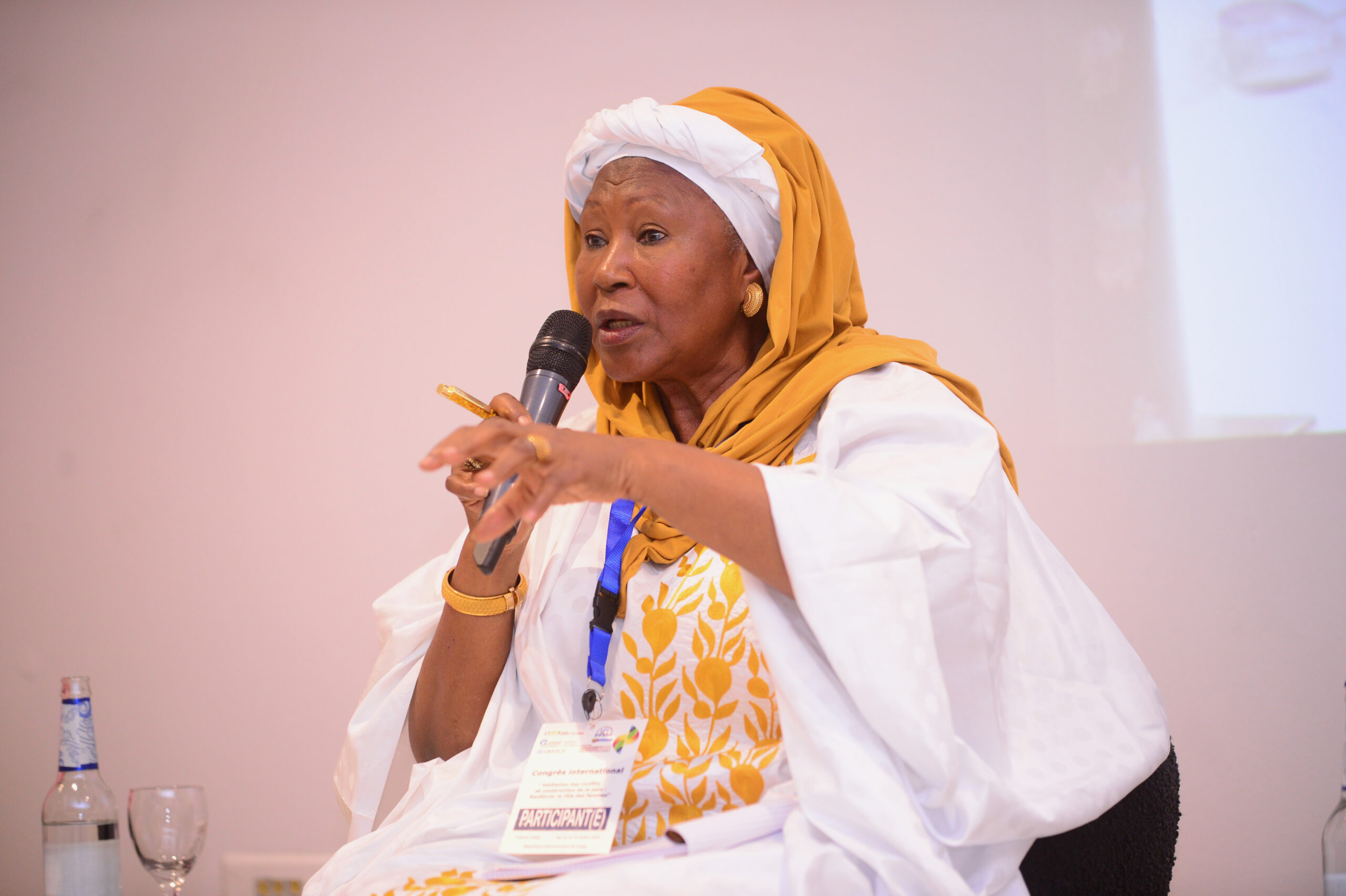
Madrid, 4 November 2025— On the occasion of the 25th anniversary of United Nations Security Council Resolution 1325, the Women for Peace Alliance an initiative of the Women for Africa Foundation in collaboration with UNAOC held an online event last Friday under the theme “Strengthening the Role of Women in Peace Mediation. The meeting featured Fatoumata Jallow-Tambajang, former Vice President of the Republic of The Gambia and one of the African leaders with whom we have the pleasure of collaborating in the area of Political Leadership, Peace, and Security.
Her full address:
Our brother Charles has always been there for us, for women, for humanity. Because when you stand for women, you stand for humanity. We sincerely thank you for your outstanding role in combating violence against women and girls.
Before I begin, it is both an honour and a pleasure for me to thank the Mujeres por Africa Foundation, for inviting us and for facilitating such an important event. We deeply appreciate Her Excellency, our sister María Teresa Fernández de la Vega, and acknowledge, in particular, her dedication to promoting women’s leadership in the areas of peace, security, and development. Today, she is represented by our dear daughter Antonina, and it is my pleasure, on my own behalf and on behalf of all participants to convey our heartfelt gratitude to Her Excellency.
Secondly, I would like us to honour all those who have lost their lives in the pursuit of peace and stability, not only in Africa, but across the world, especially women and girls.
An anniversary such as this should be a moment of reflection: a time to look back at what we have achieved since October 2000 and to look ahead, as we seek to formulate concrete solutions that will ensure that insecurity in the lives of women, and violence against women, become things of the past.
In October 2000, there was a struggle, the struggle of women and their allies, both men and women, who worked tirelessly to influence the adoption of UN Security Council Resolution 1325. For the first time in history, world leaders recognized the critical role that women play in peace and security, and in mediation, even when their contributions often remain invisible.
That moment was truly historic. And yet, after all these years, we are still here, still talking, still working at the level of advocacy and influence.
My hope, and the hope of every woman leader whom I recognize at this table, whether they are here or not, we recognize them because we know that, for circumstances beyond our control, we cannot have everyone at the table. But for reasons of humanity, when we have the opportunity as leaders to be at the table in negotiations, we must think about those who are voiceless, those who are invisible, and those who are still victims of violence.
Now, we have realized that in Africa, and in the world at large, so many resolutions have been adopted by world leaders. But if you look at the rate of implementation compared to the resources that are invested in corruption, through governments and civil society organizations, you find that it’s about 2% that is invested in ensuring that women are empowered in the areas of peace mediation, negotiations, and peace agreements. This is something that we need to reverse. And the only way we can do it is by continuing to lobby, and by making our voices heard at the political level, in the corridors of power.
Secondly, we find that women leaders are still struggling within their organizations because of a lack of funding to strengthen the capacities of their institutions—to be able to articulate policies, to lobby, and to implement projects that will truly promote human progress.
Projects in terms of economic empowerment, social empowerment, advocacy, resource mobilization, and networking, which are very important.
And I’m very happy that the grassroots activities that have been presented so far show that women leaders are now increasingly reaching out to other women’s organizations within their communities and across the African continent to dialogue and to learn from each other’s best practices that can make a real impact on the implementation of Resolution 1325.
The Secretary-General, António Guterres, spoke about the anniversary. He said—also with the Deputy Secretary-General, Her Excellency Amina Mohamed—that while so much has been said about the Resolution since its adoption in 2000, they have found that peace, and women in peace, are still under threat. The lives of women in war and in conflict zones are still threatened.
And, as my daughter Caddy says, peace is not only the absence of war, it is also the presence of fundamental rights: access to basic social services, education, health, security, food security, which now we call food sovereignty, as well as access to financial resources to move their lives forward. Because most studies have indicated that the lack of peace, the lack of resources, and the lack of opportunities for women have made them more vulnerable to poverty and to violence against women.
If women are economically empowered, they can influence decisions. They can work to ensure that policies are implemented, not in the way governments feel or deem necessary, but in a way that uplifts the lives and dignity of women.
On this note, I really want to make specific recommendations that we can put into a strategic action plan, within a clear, time-bound framework.
I am pleased to be here to guide the monitoring of policies and programs in our different countries—and also across Africa as a continent.
First of all, we need to have very strong advocacy to ensure that the adoption of the Africa Agenda 2063, which envisions a peaceful, secure, and prosperous Africa, is implemented in concert with women leaders—and, of course, in concert with men as well, because we have so many committed men who are now coming on board to support the progress and work of women.
Peace and security for Agenda 2063 can never be achieved without the participation of women and girls. So, we need to make that a recommendation, by having strategic actions, policies, and strong advocacy for resources and investment.
Secondly, we have the Sustainable Development Goals, particularly Goal 5 (gender equality and women’s empowerment) and Goal 16 (peace, justice, and strong institutions). Using an assessment-based approach, we really need to focus on data. It is very important to use data as a tool to influence policies and decisions, globally, nationally, and continentally.
The data should show where we are today:
- How many women have access to productive resources?
- How many have access to economic opportunities, education, and health services?
- How many women are participating in peace negotiations and mediations?
We need to hold leaders accountable, not only global leaders within the UN and the African Union, but also regional bodies such as ECOWAS, which has a protocol on good governance. Because at the root of women’s suffering, as victims of war, crisis, and political tension, is bad governance. If we have good governance, we will have accountability at the global and national levels.
Today, the United Nations is 80 years old—and yet Africa still does not have a permanent seat at the UN Security Council. This is something we must fight for, as women. We must support our governments and work with them so that our voices are heard in negotiations with the UN system. Africa must be represented on the Security Council. Otherwise, we continue to see one country veto decisions while others remain silent. This issue has already been raised by several governments at the UN General Assembly this year, and I am happy about that. But we, women, must not be quiet. We need to support that cause, not just to have African leaders sitting there as men-to-men representatives, but also to ensure that women are part and parcel of that Security Council and of all arms of government.
Thirdly, we need to have strong institutions, starting with our civil society organizations. We must mobilize domestic and international resources and partnerships to strengthen our institutions,to articulate policies and programs, develop advocacy tools, and equip women with the skills and resources they need to advocate for themselves.
We need policies that address poverty alleviation. Because when you look at the face of poverty, it is feminized—it wears the face of a woman. So how do we ensure that leaders develop programs that truly empower women in our societies and communities?
Fourthly, as a recommendation, we must ensure inclusivity. Among women leaders, let us bring in our younger generation.
This is my passion, and this is my commitment to women: as long as I am alive, I will not leave women alone.
I will always be where they are. I will always speak on their behalf and also allow them to speak—to empower them by mentoring them. Because, if the elders in every society have wisdom and experience, then we, as elders, must continue to support the younger generation through intergenerational dialogue, interaction, counseling, mentoring, and by providing them with opportunities.
For our children who have dropped out of school, those who, for financial or other reasons, have faced hardship, we should encourage and ensure that institutions and governments put in place an enabling environment to bring them into the mainstream of development. This can be done by providing after-school programs and dropout recovery programs, to ensure that they understand their rights.
The rights of women are the rights of humanity. These rights of every individual are inalienable. And they are called inalienable because you are born with them, you don’t acquire them. They are fundamental rights that everyone should be able to exercise.
My final point is this: Mujeres por África, Charles, with your organization and all other partners, you have a great role to play. You have been playing that role effectively and excellently. But again, we would like to encourage you to continue.
It is not easy to have a man advocating for women, I know that difficulty. And I know that it is because of your commitment and your passion that you are where you are with us today. We encourage you to continue to find resources for the Coalition for African Women Peace Mediation, so that it can have more capacity and resources.
However, these resources must be institutionalized, directed toward specific activities that can be monitored and measured. Because accountability in governance is very important. If resources are provided, whether as projects or as grants, we must have audits to review the organizations annually or biannually, depending on available resources. But this must be a standing measure to ensure the effectiveness and sustainability of every organization.
So Charles, we encourage you. We give you that responsibility, and we assure you of our continuous commitment and appreciation for Mujeres por África.
Mujeres por África, we want to send you the same message: we appreciate all that you have been doing for us, and we want you to continue. The platform we are on today must become one of the key instruments that enables Mujeres por África to mobilize effectively—to have the capacity to move resources, especially for women in the most difficult areas.
I am here in The Gambia. It is relatively peaceful, but I do not sleep. I cannot sleep when I know that in the DRC, in Zaire, in Sudan, in Somalia, and in other crisis-affected countries, women and children are suffering.
I cannot eat when I know that my fellow women—my children, because a mother is always a mother to everyone—have nothing to eat, no place to sleep, and do not know where their next meal will come from.
So, we must look at peace and security beyond the mere absence of war or violence. We must see it as the presence of gender equality, in policies, programs, and investments.
Let us hold our governments accountable to ensure that whatever investments they make, including through the World Bank and the Bretton Woods institutions, truly promote good governance and women’s empowerment. Because if you measure the impact of these investments in our countries compared to how they empower women, you will find that it is only tokenism.
So let us be very strong. Let us never despair.
I am here to support you. I will always support you in whatever way you feel I can help. On that note, I want to sincerely thank you and pray that God continues to guide and bless you.
And I leave you with a very good and encouraging note.