“Science without borders”: highlighting the leadership of African women researchers in the Canary Islands
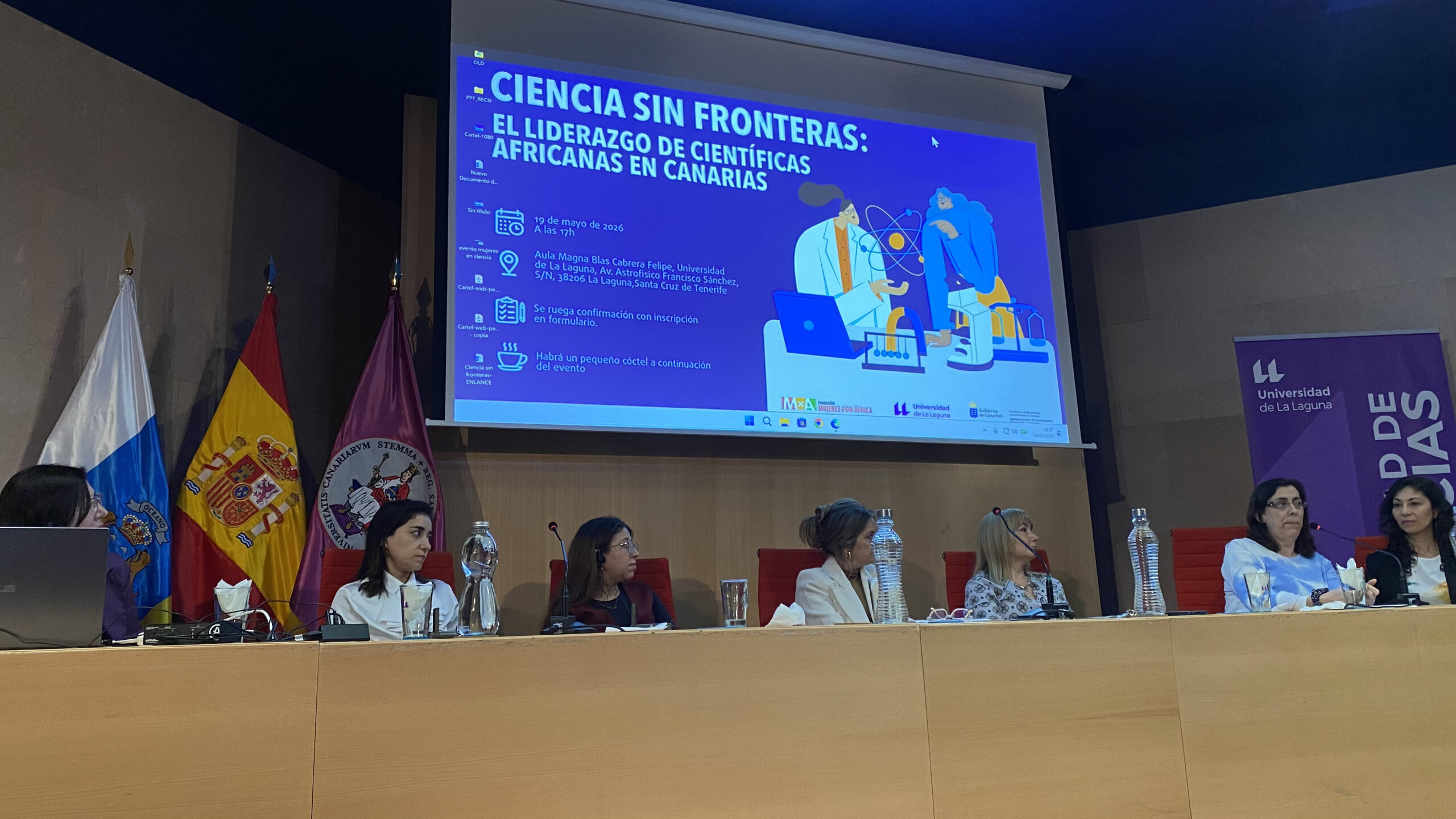
Wednesday, May 20, 2026 – Yesterday, the Aula Magna Blas Cabrera Felipe at the University of La Laguna hosted an institutional and scientific gathering organized by Fundación Mujeres por África together with ULL, the University Institute of Women’s Studies (IUEM-ULL), the Scientific Culture Unit, the Cultural Classroom for Scientific Outreach, and the Canary Islands Agency for Research, Innovation and Information Society (ACIISI).
Under the title “Science without borders: the leadership of African women scientists in the Canary Islands”, the event brought together institutional representatives, researchers, and scientific centers around a central question: how can the Canary Islands become a space for encounter and shared knowledge production between Europe and Africa?
Cooperation that must be horizontal
The event opened with interventions that set the tone for the discussion. María Inmaculada González Pérez, Vice-Rector for Internationalization and Cooperation at ULL, emphasized the mutual benefits of building stronger relations between Europe and Africa and reaffirmed the institution’s commitment to promoting African women’s talent. Meanwhile, Javier Franco Hormiga, director of ACIISI, positioned the Canary Islands as an international knowledge hub, highlighting four key pillars for high-quality scientific cooperation: good governance, funding, scientific culture, and internationalization. He also noted that the Canary Islands are one of the few — if not the only — autonomous communities in Spain with a specific Canary Islands–Africa strategy.
Fundación Mujeres por África highlighted the role of the Science by Women programme as a driving force for scientific cooperation through women, while stressing the need for institutions capable of supporting and sustaining these initiatives over time.
Institutional panel: from intentions to concrete actions
The first panel, focused on institutions as drivers of African women’s scientific leadership, explored how to transform declared commitments into real policies. González Pérez emphasized ULL’s strategic tricontinental position — looking toward America, Europe, and Africa — and outlined the concrete mechanisms through which the university puts that vision into practice: mobility programmes, knowledge transfer, networks, and scholarships.
Nasara Cabrera, Director of Cooperation at the University of Las Palmas de Gran Canaria, introduced a reflection that is often overlooked: the need to incorporate a gender perspective into the evaluation of university cooperation programmes. She pointed out that, in train-the-trainers projects, male profiles are often prioritized. This does not happen because qualified women are lacking, but because they are simply not being sought out. She also stressed the urgent need to create female role models both in Europe and across the African continent.
The discussion evolved into a shared reflection on the need to decolonize scientific cooperation, understand knowledge transfer as a two-way process, and ensure continuity so that initiatives do not remain isolated actions.
Testimonial panel: science experienced firsthand
The second panel offered the most personal moment of the event. Researchers from the Science by Women programme shared how their stays in the Canary Islands had transformed their professional trajectories.
Amira Tawfeek, a researcher at the Canary Islands Institute of Astrophysics, explained that the experience had encouraged her to advance further in her career. Sywar Belkahla, a researcher at the Oceanic Platform of the Canary Islands (PLOCAN), spoke about how the collaboration had enabled her to integrate a multidisciplinary perspective. The participating Canary Islands scientists highlighted the structural obstacles within the system: bureaucratic rigidity acting as an additional barrier for women, the difficulty of exercising leadership while balancing family responsibilities, and the need to redefine what leadership can look like according to each woman’s personal and professional journey.
The importance of science communication was also discussed in order to dismantle the idea that there is such a thing as “gendered science.” There is no male or female knowledge, but there are unequal barriers to access.
An event that leaves a mark
The event, held within the framework of Fundación Mujeres por África’s Science by Women programme, made clear that the Canary Islands have both the vocation and the conditions to become a meeting point for scientific exchange between continents. It also demonstrated that highlighting the leadership of African women researchers is not only an act of justice, but also a strategic commitment to a more diverse, connected, and powerful science.