Learn Africa: public-private partnerships that transform lives and help address the major global challenges of our time
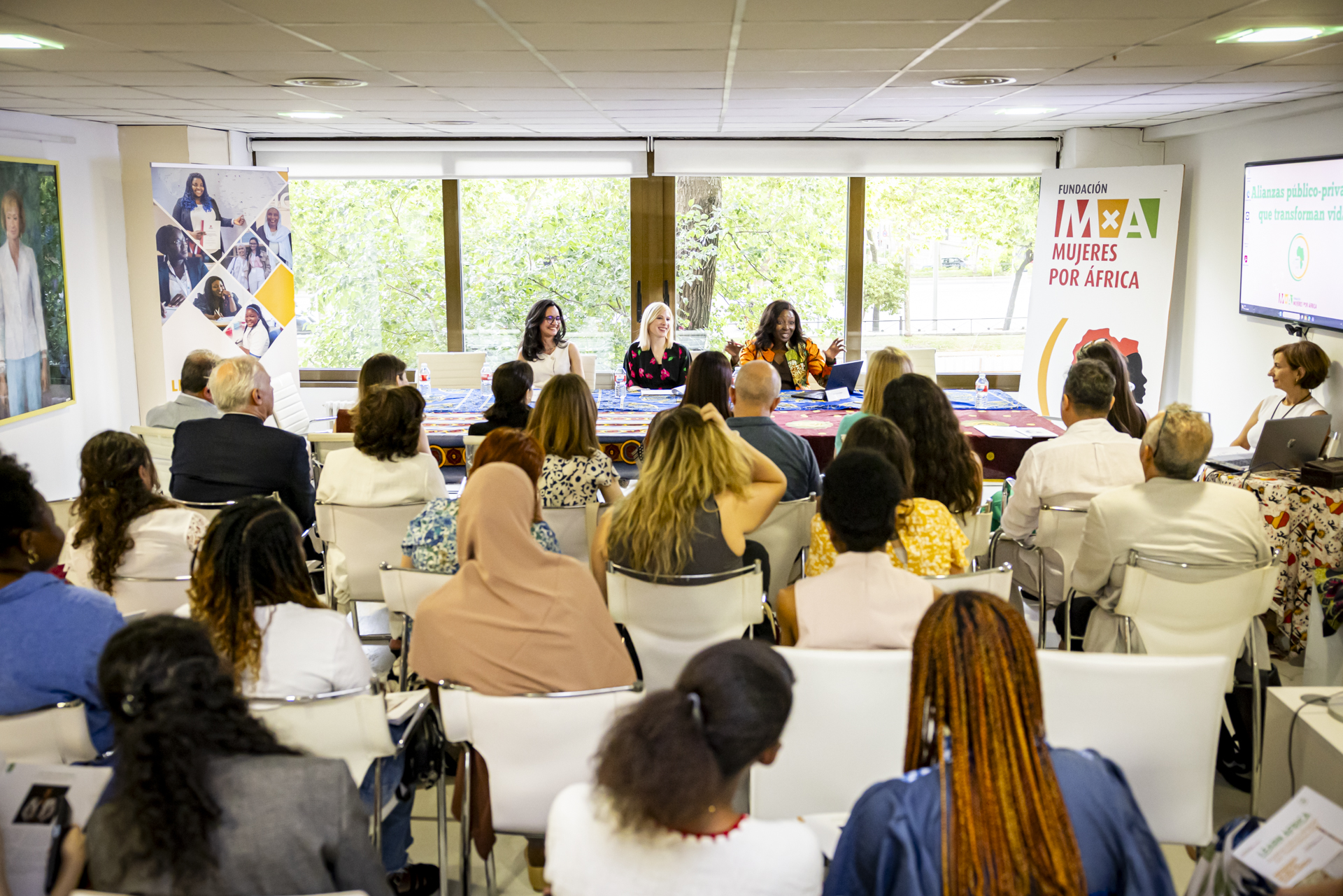
Madrid, 26 June 2026 — The Women for Africa Foundation held an institutional event yesterday, 25 June, at its Madrid headquarters as part of the Learn Africa scholarship programme, which since its founding in 2013 has enabled 461 African women to pursue postgraduate studies at Spanish universities. The event brought together three scientists supported by the programme alongside representatives of the academic institutions, companies, and foundations that make it possible in a space for recognition and reflection on the value of public-private partnerships in advancing African women’s scientific leadership.
Three journeys, one shared impact
The event opened with testimonies from the beneficiaries themselves. Dr. Meryeme Boumahdi, an R&D engineer specialising in photogrammetry and geospatial intelligence, trained through the partnership between the Universidad Politécnica de Madrid and GMV, described her scholarship as “an experience of resilience and transformation on every level” and spoke about the ripple effect her journey has had on the women around her, who see in her an alternative model to traditional expectations. Boumahdi currently works as an R&D&I engineer in drone technology at a Swiss company based in Madrid, where she is the only woman on her team.
From Sierra Leone, Dr. Rashidatu Fouad Kamara, an epidemiologist and public health specialist who works with the WHO Regional Office for Africa, joined via video. Having completed her doctorate in Epidemiology and Public Health at the Universidad Rey Juan Carlos through the Humanitarian Medicine Chair funded by the Fundación Asisa, she encouraged future beneficiaries to seize the opportunity that Learn Africa represents, and stressed that women with higher education do not only transform their own lives, they also contribute to advances in science, public health, and sustainable development.
Dr. Gloria Dada Chechet, a molecular parasitologist and associate professor at Ahmadu Bello University in Nigeria, highlighted the lasting value of the relationships these scholarships generate and drew attention to the difference between being present, having a voice, and having real influence in scientific decision-making spaces. As principal investigator of the MultiplexAI consortium, she collaborated with theCarlos III Health Insitute with the support of the Fundación Anesvad.
The partnerships that make the programme possible
The institutional roundtable, moderated by Beatriz Santacruz García, Learn Africa’s programme coordinator, brought together representatives of the three partnerships that made possible the scholarships we celebrated: the Universidad Politécnica de Madrid and GMV; the Universidad Rey Juan Carlos and Asisa Foundation; and the Instituto de Salud Carlos III and Anesvad Foundation.
Ignacio Ramos of GMV argued that private companies have a debt to society, and that funding initiatives like Learn Africa is one way of repaying it — particularly in the case of a company that was born from, and continues to draw on, talent trained in public universities. His reflection on the power of pooling resources around a shared goal was among the most warmly received of the day.
María Tormo of Asisa Foundation expanded on the scale of the impact by noting that investing in profiles like Dr. Kamara’s is tantamount to investing in global health: in an interconnected world, a pandemic or epidemic originating in Africa — or anywhere else — can affect the rest of the globe. For Asisa, she said, supporting Learn Africa means investing in society as a whole.
María González of Anesvad Foundationunderscored the urgency of funding more local research on neglected tropical diseases (NTDs), which affect Africa disproportionately and whose specific impact on women remains insufficiently studied. The perspective of African researchers themselves — women who encounter these realities in their daily lives — is, she emphasised, an irreplaceable scientific asset.
Consuelo Gonzalo of the UPM noted that Dr. Boumahdi’s success cannot be attributed to academic excellence alone — her thesis was awarded an international mention with cum laude distinction, placing it among the university’s highest-rated — but also to her collaborative approach, her resilience, and her ability to thrive in a multicultural environment.
Miguel Ángel del Río of the URJC was another speaker who drew a particularly warm response when he stated that funding initiatives like Learn Africa is, above all, a matter of social justice, and when he argued that, at a time when international cooperation is facing serious setbacks, programmes like this one offer a ray of hope to those who believe in the fight against inequality.
Finally, Isra Cruz of the Instituto de Salud Carlos III identified two key challenges ahead in scientific cooperation with Africa: the need to decolonise research by ensuring a more equitable distribution of funding and greater representation of African scientists in international teams, and the full integration of the continent’s Francophone and Lusophone countries, whose scientific output continues to be constrained by the English-language barrier.
Thirteen years building the future
The event closed with a Spanish wine reception that extended the conversations begun around the roundtable. Beyond the individual testimonies, the day made clear something the programme has been proving for over a decade: that when academia, the private sector, and civil society join forces, it is possible to transform lives and help address some of the greatest global challenges of our time.


