Dr. Joy Odimegwu: “breast cancer mortality rates in sub-Saharan Africa are 2–3 times higher than in high-income regions”
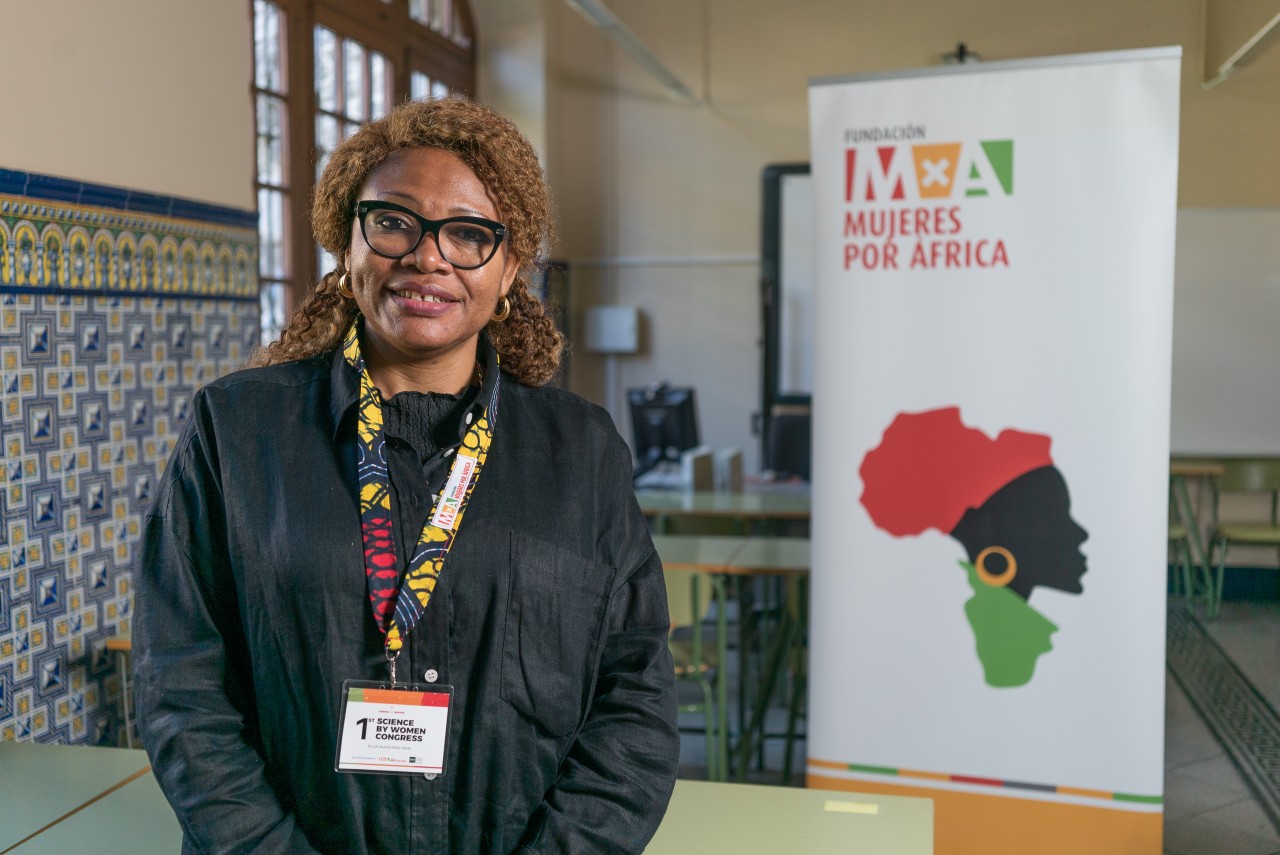
October is Breast Cancer Awareness Month, a time to shed light on one of the most common forms of cancer affecting women worldwide. To mark the occasion, we spoke with Dr. Joy Odimegwu, a Nigerian researcher who spent last year at the Castilla-La Mancha Health Research Institute through the Science by Women program.
Dr. Odimegwu’s work focuses on using nanotechnology to enhance the formulations of natural medicines, particularly for cancer treatment and pain management.
Conversations like this matter. To address the growing cancer burden across the African continent, it is essential to amplify the voices of women scientists who are advancing research and developing solutions tailored to their countries’ unique contexts and needs.
Only one in two women diagnosed with breast cancer in sub-Saharan Africa survives five years, while in high-income countries the five-year survival rate exceeds 90%. Last year, you told us: “In Africa, a breast cancer diagnosis is a death sentence.” Why does this gap remain so wide?
My comments in 2024 about breast cancer diagnosis unfortunately still hold today because nothing has changed for the better.
The statistics on record may not even be factual, and I will explain.
The situation is even more serious for most of sub-Saharan Africa, except for South Africa. The Global Burden of Disease (GBD) 2019 study found that breast cancer mortality rates in sub-Saharan Africa are 2–3 times higher than in high-income regions.
I say they could be 5 times higher because many die without ever getting to a hospital, so there are no records of their death.
Late-stage diagnosis is very common. In the literature, it says that over 70% of African women are diagnosed at stage III or IV, compared to less than 20% in high-income countries.
But in reality, they could be more because we have a diagnosis problem. It is expensive, and so a great number of patients remain undiagnosed and die from complications.
Studies show that around 60–70% of women in African countries are diagnosed at a late stage. Is late diagnosis the main reason for the high mortality rate, or are there other contributing factors?
Late diagnosis is the leading cause of mortality, but there are other reasons as follows:
Firstly, Stigma delays detection until advanced stages. Yes, people and families can still be stigmatised for cancer diagnoses, though it’s a non-communicable disease.
Secondly: Drastically limited access to treatment: Scarcity of oncology centers, radiotherapy, and chemotherapy and of Doctors specialized in these areas. 2 years ago, our healthcare situation was bad, Now, at least in Nigeria, where I live and work, it is dire. Many medical Doctors have migrated to developed economies where their work is valued and they earn living wages.
Thirdly: Financial Barriers; Out-of-pocket costs prevent many from completing treatment. Health System Challenges: Weak referral systems, poor data tracking, and limited pathology services.
Fourthly and finally: Cultural & Social Factors; Fear, myths, and gender dynamics hinder early care-seeking.
Reports indicate that in Nigeria, most breast cancer patients are young, premenopausal women who are diagnosed with advanced disease. What explains this trend, and what does it tell us about the nature of breast cancer in Nigeria?
Breast cancers are being diagnosed in all age brackets in Nigeria. There is a recent trend among the 40s and 50s peri-menopausal women, just like the upsurge of Colorectal cancers among the 20-40 year olds in Europe.
This trend is still inexplicable. I believe from my experiences that cancers are mostly a lifestyle disease.
Some of them can be prevented with healthy nutrition and exercise. Most countries in the developed world are investing heavily into cancer prevention strategies through high fruits and vegetable consumption and exercises.
Research reports have also confirmed this as the right approach, as there are significant positive reports from patients who change lifestyles for healthier ones and do not have recurrence of cancer,s unlike the patients who do not.
In Nigeria, health care spending is mostly out-of-pocket. How does this financial burden affect women’s access to diagnosis and treatment?
It is a national problem and affects males and females. Women are more affected because of the childbearing burden.
There are health insurance schemes for those in organized labour but majority of the citizens are not in organized labour so they are without the safety net of health insurance and the situation is critical. Healthcare is not affordable, not accessible and not available for a wide swathe of the populace.
Many, about 70% or more, therefore depend on Traditional medicines, which are effective and gradually being better regulated. My research in the area has shown astounding results for breast cancer treatments.
Beyond financial constraints, what other barriers prevent Nigerian women from seeking or continuing treatment?
Beyond financial constraints, Nigerian women face multiple barriers to seeking or continuing health treatments.
Limited or no access to healthcare facilities, especially in rural areas, and a shortage of female healthcare providers (mostly for Northern Nigeria). Most functional health facilities are in the urban areas. There are also safety concerns as insecurity has grown in the last 2 to 3 years. There are terrorists operating unchecked in some areas of the country.
Cultural beliefs, stigma, and fear of a serious diagnosis discourage early intervention. These pertain mostly to mental health issues and some gynaecological issues.
Poor health literacy and misinformation reduce trust in medical systems. A good number of people do not believe Doctors at all due to widespread stories of a few deceitful ones. Also, long wait times, inadequate diagnostic tools, and fragmented referral systems further complicate care. These are caused by poor electricity in some areas of the country, and patients are kept waiting because the hospitals are so ill-equipped and lack backup power plans.
Family responsibilities and lack of social support also hinder attendance at health centres.
Your research focuses on developing herbal medicines for breast cancer. Why is this line of research particularly relevant in the Nigerian context?
My research in over 20 years has been on drug discovery from plants, especially those used as food too. Recently, in the past 5 years, I have transitioned to translational drug delivery of herbal medicines for cancers, microbial infections and pain. The transition was because of societal needs. 70% to 80% of Nigerians, and in fact globally, according to WHO research, depend on herbal medicines, and though a lot of giant strides have been made in that space, there are still gaps to do with dosage forms and standardisation of the medicines.
I chose to be a part of the solutions by contributing to filling the necessary gaps and to improve the health care situation in Nigeria, Africa and globally.
Could herbal-based treatments potentially help reduce the overall cost of cancer care?
Yes, of course, herbal medicines are cheaper and quite effective. Case in point is my research findings from yams, a staple crop in Africa, Broccoli, though temperate, grows well in the colder parts of Nigeria and sour sop fruits and leaves, which grow well in the tropics.
I am currently working on completing the Nanomedicine research to perfect the dosage forms of these herbal medicines for targeted therapy in cancers. Thanks to Mujeres por Africa and The Lab of Prof.Ester Vázquez Fernández-Pacheco at the University of Castilla-La Mancha for the strides that I have achieved in this area.
However, I need more financial resources to be able to get the quite potent Nanomedicines tested for safety and then to the clinics for wider positive impacts in the lives of people not only in Africa but globally.
My research results show that late stage cancer patients could be helped to have a better quality of life and my determination to pursue this line of research, living NO ONE BEHIND has led me to produce BROCCULUS®, pure broccoli; blanched, dehydrated and powdered so one consumes a concentrated amount of Sulforaphane; the natural anti-cancer constituents which modulates estrogen and testosterone thereby hugely helpful for prostate and breast cancers and other hormone dependent cancers.
This month marks Breast Cancer Awareness Month. From your perspective as a researcher, what are the biggest challenges that still hold back progress in your field?
Money. We already have the expertise. Financial support will provide infrastructure for scaling up already effective herbal medicines to the stratosphere. It will enable researchers like me to train others and hence generate a ripple effect so that the efficient medicines which are trusted by people will be accessible, available and save so many lives.
I will like to collaborate with Private companies/Individuals who can invest in this research and be patient to get their ROI in a good time, as well as the human feeling of having helped to reduce the cancer scourge. If I have even a small percentage of the investment thrown at Tech, I will do so much, so much more.
Finally, if you could share one key message with women about breast cancer prevention and care, what would it be?
Breast cancer is preventable. Eat nutritionally well, especially fruits and vegetables. Be intentional in eating healthily and keep moving with home exercises too.
I will be specific. Incorporate vegetables in all meals or at least once daily.
Spend 15 minutes performing some form of exercise daily.
Thank you so much for the opportunity to speak and get all these out.